A few weeks ago, I read Bret Stephens’s opinion piece in The New York Times, “I’m Begging You: Never Write With A.I.”. His argument is that writing compels thought, and that mundane writing builds the muscle you need for more important writing. If you let AI take over any of that work, the muscle will atrophy. He includes “emails (however perfunctory) to your colleagues or friends” in his plea.
That line really bothered me. I agree that some writing needs to stay hard, but the emails I send my students aren’t that sort of writing. The argument doesn’t survive contact with the real world.
The point of a student email isn’t the writing. When I’m explaining an assessment to a student or floating an idea to a colleague, I don’t owe them a demonstration that I personally typed every word. What matters is clarity. Making sure the information I’m trying to pass on is clear may be more ethical than diligently writing every word myself. Nobody is best served by me struggling through sentence construction if the result is a message that’s harder to understand.
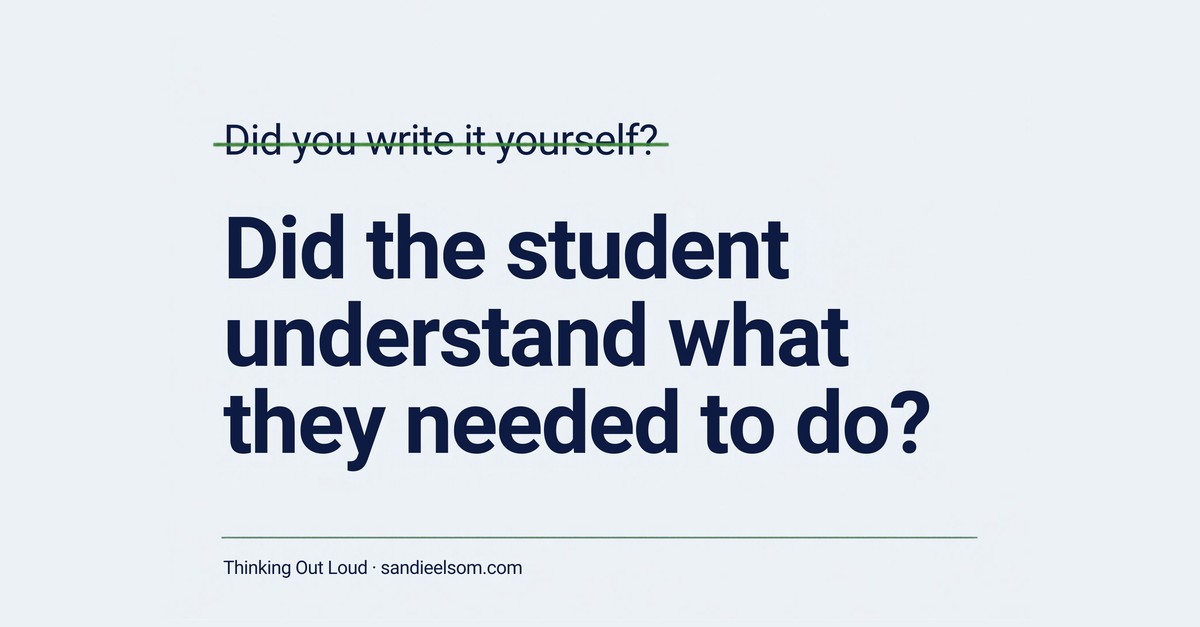
Stephens’s framing treats Did you write it yourself? as the question that matters. For a student email, I think the more useful question is: Did the student understand what they needed to do?
In a busy workday, responding to student emails means switching contexts. I could, like plenty of academics, let them sit until the end of the day and answer them all in a batch. There’s nothing forcing me to reply straight away. But my students are busy too. They have tight, overlapping deadlines, and when they email me, they’re often in the middle of doing the work. If I can get back to them quickly, I want to. I know what it’s like to be pulled out of a flow state while waiting for an answer for something that could be resolved quite quickly.
But I’m also in the middle of something. I might be designing a lecture, working on a research project or writing a paper. To answer a student properly and in good time, I have to stop, shift my thinking out of whatever I was doing, formulate the answer in my head, and then do the separate work of turning that answer into a clear, well-written response. That shift takes effort, quite apart from the writing itself.
With AI-supported responses, the thought is still my own. I have the answer in my head, and I can speak it aloud. AI helps me turn that answer into a reply while my attention is still half in the other task.
When I say I use AI to write emails, I don’t mean that I hand the whole thing off and let it go out unreviewed. I give it the substance of what I want to say, check what comes back, and edit or personalise it before I click send. It can draw on how I’ve answered this kind of question before, so the result is often more tailored to that student’s situation than something I might produce while my brain is still in the other task.
That’s only one part of the benefit of using AI to help with my emails. Because I’m not starting from a blank page each time, those conversations become a bank of responses. When I ask AI to help with a reply, it can draw on what I’ve told students before: decisions I’ve made about an assignment, nuances I’ve explained, exceptions I’ve allowed, and why I made those decisions. Sometimes it picks up on something relevant that I’ve forgotten to mention.
The accumulated picture of what my students don’t yet understand is worth more than any individual reply. It helps me identify confusion and rebuild my learning materials to address it before it happens again, rather than cleaning up after it. That bank of emails becomes a source of information about what’s happening in my course and with my learners.
The same thing happens with marking. I understand that saying AI helps with marking can make people uncomfortable, and I don’t support every way it might be used. Here is how I use it: I mark the work myself. I decide what a student has and hasn’t demonstrated, and what grade that earns. A marking tool I’ve created takes my spoken feedback and helps me turn it into a response that tells the student why they received that mark and how they can improve next time.
Detailed feedback takes time to write well, especially across a whole cohort. There may be opportunities to outsource the marking itself, but among the academics I work with, that’s not something we want to do. Marking is one of the main ways we find out how our students are progressing and whether they’ve understood the learning material. If AI takes over that thinking, we lose the signals that tell us how to help them.
So, AI’s role in my marking stays subsidiary to mine. I mark the work, decide on the feedback, and use it to help me write that feedback clearly and consistently.
Over time, the email conversations and marking feedback become sources of insight in their own right. The email or feedback comment is the visible output. The greater value may be in the information accumulating underneath it, which I can return to when I sit down to redesign my teaching.
There has been concern lately about watermarking AI-generated writing. I think part of what makes this feel threatening is the stigma around using AI. People don’t want to be identified as using it to support their writing. That’s not my situation. I’m transparent about it with my students and colleagues, and I’m being transparent about it here: I speak my thoughts and ideas into an AI conversation and develop them over time, then I draw out a single idea that’s been on my mind and, working with AI, develop it into a blog post. The stigma relates to the perception that a person is attempting to pass off AI-assisted writing as their own. The solution to that is transparency. The fix for stigma is not a technological one.
I’m not claiming that AI is unproblematic. There are serious questions about power and energy use, data centres being built in places where they draw on local resources without communities having a say, and the uncompensated use of other people’s intellectual and creative work to train models. I don’t understand those issues well enough to argue them here, but I don’t want to minimise them. They are real concerns.
The point I want to make is narrower. Given that this technology exists, it lets me redirect time away from drafting emails and building slides from scratch and towards something admin work cannot substitute for: time with my students.
Many of the adult learners in my courses have had negative experiences with education before they reach me. One-on-one time can be especially important for them. I would argue that it matters to every student; its importance just tends to be named more explicitly in the enabling education I teach. That is the trade I’m making with the time AI gives me back. I’m not making less effort. I’m putting more effort into the parts of my job that only a person can do.
None of this means that struggle in writing has no value. It depends on what you’re writing for. When you’re writing for publication and learning something new, the struggle is part of the process. Even if I use AI to help me understand something, I still have to do the cognitive work of learning it. Writing for publication is difficult. I’ve worked at it for years, and I still find it hard. Some people have a gift for it; others put in the hard yards to get good at it. Either way, it doesn’t become easy.
It can be satisfying precisely because it’s hard. There’s value in looking back at something you’ve produced and knowing that you got there yourself, word by word, sentence by sentence. Those opportunities aren’t disappearing from academic jobs. There’s no shortage of that kind of writing, so I’m not worried about losing the skill. A perfunctory email was never where I was developing that skill in the first place.
Stephens uses the analogy of an escalator and the stairs: take the easy way often enough, and you lose the capacity to do it the hard way. It’s a good metaphor when the difficulty is the point. But a student email is rarely just a question about a due date. More often, a student wants to know whether they can do something slightly outside what’s written in the course materials. Answering properly means weighing what the assessment is trying to achieve against the value of what they’re asking to do. I have to work out how far I can tailor their path through it without compromising their learning or the integrity of the assessment.
I make those decisions each time. That is real cognitive work, and AI isn’t taking that judgement off my hands. It helps me turn the judgement I’ve already made into a clear reply. That gives me more time for the things that matter most in my work: reading, thinking and building relationships with my students and colleagues.

